
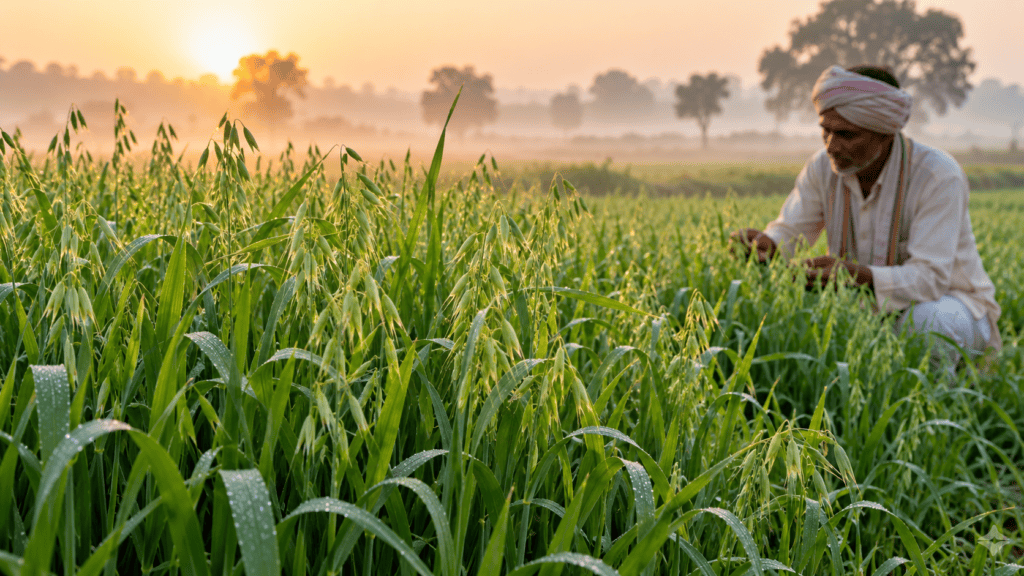
Oats Seeds for Fodder: Rabi Sowing Guide
Oats seeds sowing time decides how well your winter fodder crop performs, and for most farmers the window is short, running from October to about mid-November. Oats are one of the easiest rabi fodder crops to grow: they handle cold weather, ask for very little fuss, and give a bulky, fiber-rich green fodder that cattle eat readily. Sow them on time and prepare the field properly, and you get dependable fodder through the cold months with far fewer headaches. This guide covers sowing time, seed rate, irrigation and harvesting, so you can plan your field step by step.
Why Oats Work So Well as a Rabi Fodder
Oats may not get as much attention as berseem or lucerne, but they earn their place in a winter fodder plan for good reasons:
- Fiber-rich – supports digestion and balances a protein-heavy diet
- Cold tolerant – grows well in cool winter weather
- Easy to manage – fairly forgiving, even for first-time fodder growers
- Flexible use – can be fed green, or made into hay or silage when there is extra growth
- A good partner crop – pairs well with berseem or lucerne, giving fiber alongside protein
Oats offer moderate protein (around 10-12%), so many farmers feed them together with a legume fodder rather than on their own.
Best Oats Seeds Sowing Time
The best oats seeds sowing time in most parts of India is October to mid-November, when the weather turns cool and the soil still holds some moisture left from the monsoon.
- Mid-October to early November is the ideal window, giving the crop enough time to tiller well and give more cuttings
- Late November or December sowing is possible, but yields are lower because the plants get less time to grow before the weather warms up
- Sowing in leftover heat can lead to uneven germination, so wait for properly cooler days
If you want a steady supply of green fodder through the winter, sow in two or three batches, 10-15 days apart, instead of sowing the whole field in one go.
Soil and Field Preparation
Once your oats seeds sowing time is fixed, the next job is preparing the field. Oats grow in a wide range of soils but do best in well-drained loam. Avoid fields where water stands for long.
- Plough the field 2-3 times and level it properly
- Mix in well-rotted farmyard manure to improve soil structure
- Remove weeds and old crop stubble
- Make a fine seedbed so that the seed makes good contact with moist soil
Seed Rate and Sowing Method
For fodder, the seed rate for oats is around 35-40 kg per acre (roughly 80-100 kg per hectare), a little higher than for grain, because a dense stand gives more green fodder. Always check the recommendation for your variety on the seed pack.
- Line sowing at 25-30 cm row spacing and about 3-4 cm depth gives an even stand and makes weeding easier
- Broadcasting works for small plots, followed by a light harrowing or ploughing to cover the seed
- Choose fodder varieties (multi-cut types) rather than grain varieties if your goal is repeated cuttings
- Use clean, high-germination seed to avoid gaps in the field
Irrigation and Fertilizer
Oats need less water than berseem, but they still need regular moisture for lush growth. Give a light irrigation after sowing if the soil is dry, and then irrigate every 15-20 days depending on soil type and weather.
Oats respond well to nitrogen. A basal dose at sowing and a top-up after the first cutting, as per your soil test or local recommendation, helps the crop regrow quickly. Keep an eye out for weeds in the first month, because young oats can be crowded out by faster-growing weeds.
Cuttings and Harvest Stage
Counting from your oats seeds sowing time, the first cutting is usually ready around 55-60 days later, when the plants are tall and leafy and before flowering is far along. With multi-cut varieties, a second cutting can follow about 30-35 days after the first, giving you 2-3 cuttings in a season.
Cut a few centimeters above the ground so that the plants can regrow. Do not wait too long, because older oats turn stemmy and become less palatable for cattle.
Oats Sowing at a Glance
| Factor | Guide |
|---|---|
| Sowing time | October to mid-November |
| Seed rate | 35-40 kg per acre |
| Sowing depth | 3-4 cm |
| Row spacing | 25-30 cm |
| Irrigation | Every 15-20 days |
| First cutting | 55-60 days |
| Total cuttings | 2-3 per season |
Pairing Oats with Berseem or Lucerne
Oats give fiber and bulk, while berseem and lucerne give protein. Growing them in neighboring plots, or feeding them together, gives a more balanced ration than any one of them alone. A simple practice is to sow oats and berseem in adjoining plots, so that one crop is being cut while the other regrows, and you always have fresh fodder on hand.
Common Mistakes to Avoid
- Missing the oats seeds sowing time window and sowing very late in December
- Using a grain variety when you want repeated fodder cuttings
- Sowing too deep or too thin, which leaves gaps and invites weeds
- Skipping nitrogen after the first cutting, which slows regrowth
- Cutting too late, when the stems have turned hard and woody
Conclusion
Oats are simple, reliable and well suited to Indian winters, but they reward farmers who respect the calendar. Getting the oats seeds sowing time right, along with a fine seedbed, the correct seed rate and timely cuttings, gives you fiber-rich green fodder that fits neatly beside berseem or lucerne in your feeding plan. October and November are the months to act, so organize your seed and your field a little ahead of the sowing window.
Looking to buy quality oats seeds? Check out our Fodder Seeds page for the best prices per kg, with delivery across India.